.

Building the future of humanity in space


TERRAN_R_LAUNCH.png
 

TERRAN R

OUR NEXT-GEN REUSABLE 3D PRINTED ROCKET

Building on over seven years of experience and momentum gathered through the Terran 1 program – the world’s first 3D printed rocket to fly and reach space – we’re accelerating the company’s focus on Terran R to meet significant market demand. Terran R also represents a large leap towards our mission to build humanity’s multiplanetary future, eventually offering customers a point-to-point space freighter capable of missions from Earth to the Moon, Mars, and beyond.

As a two-stage, 270-foot-tall rocket with an 18-foot diameter and a 5-meter payload fairing, Terran R is a customer-centric launch vehicle designed to meet the needs of commercial companies and government entities sending payloads into LEO, MEO, and GEO. Terran R will prioritize first stage reusability, with the capability of launching:

  • 23,500 kg to Low Earth Orbit (LEO), downrange landing

  • 5,500 kg to a Geosynchronous Transfer Orbit (GTO), downrange landing

  • 33,500 kg max payload to LEO, expendable configuration

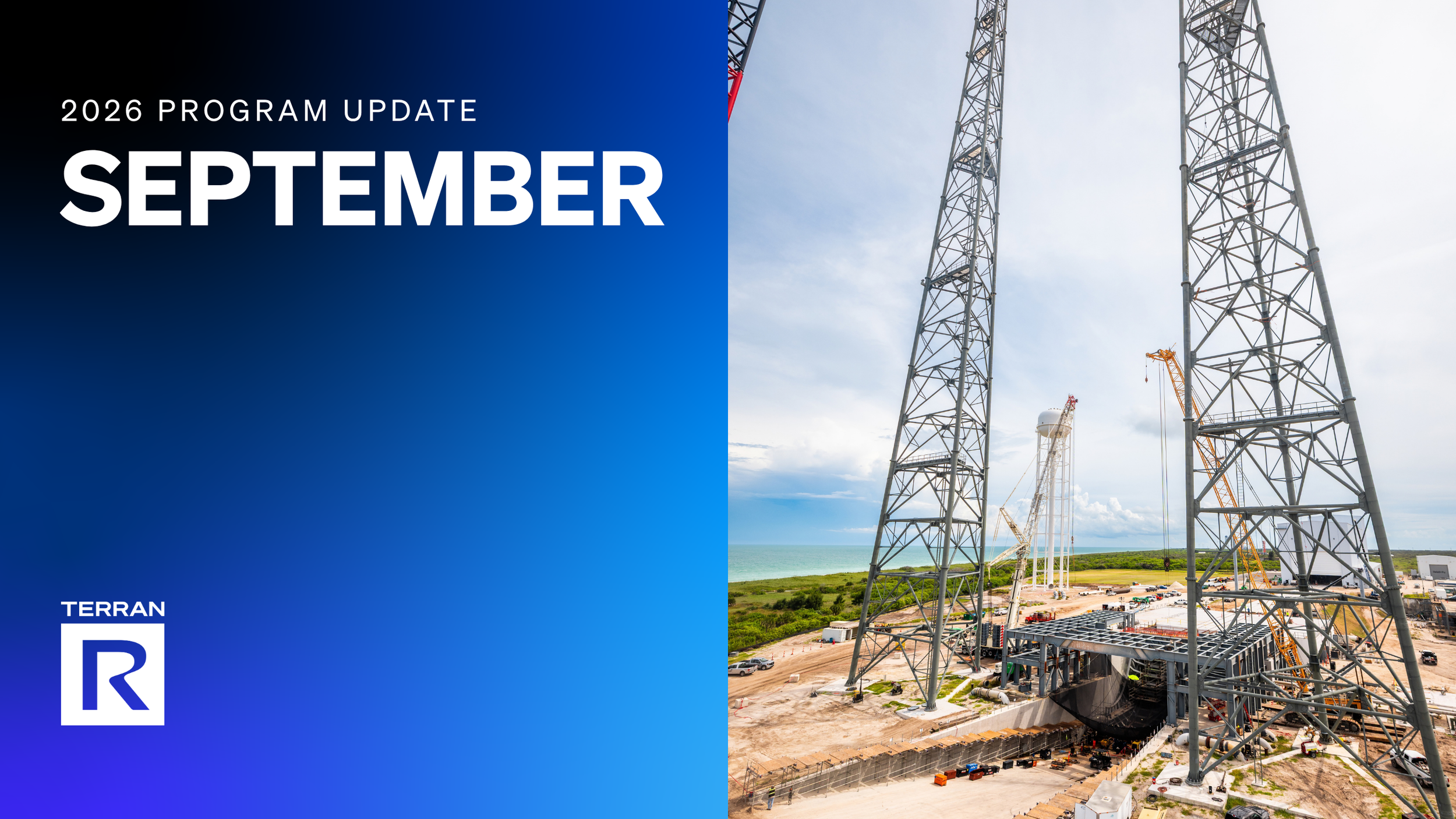
Starting in 2026, Terran R will launch from Space Launch Complex 16, the company’s orbital launch site at Cape Canaveral, Florida.

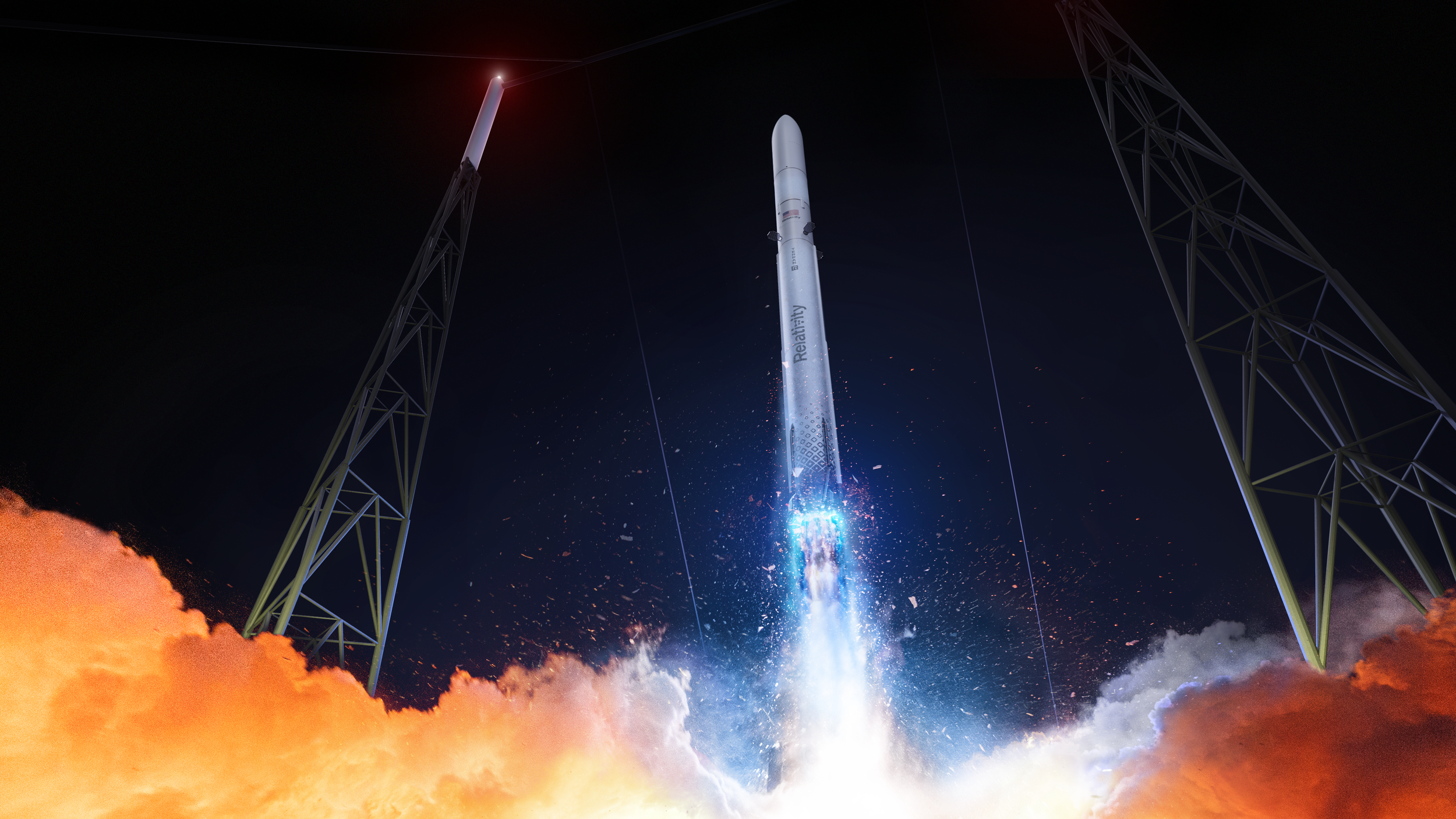
A fully stacked Terran R rocket beside its reusable first stage


 BRINGING THE BEST OF TERRAN 1 TO TERRAN R


The technologies created throughout the Terran 1 program were intentionally envisioned to build direct experience relevant to Terran R. This approach was not the easiest path to get Terran 1 to the launch pad – as an ambitious first vehicle – but it will now enable our team to capitalize on a significant experience base while executing Terran R. Ultimately, Terran 1’s flight delivered highly valuable data to inform and anchor our models and simulations. The following is directly applicable to both the ascent and entry/reusability on Terran R, based on the design, analysis, development, qualification, certification, and flight test approaches from Terran 1:

  • Ascent launch vehicle complexity and development sophistication relevant to a larger program like Terran R

  • Primary 3D printed structures and integrated structures designed for dozens of cycles

  • High performance, 3D printed, liquid oxygen/methane propulsion systems using a gas generator (GG) combustion cycle

  • Guidance, navigation, and control algorithms and in-house developed trajectory software

  • Structural dynamics and vibro-acoustics

  • Aerodynamics and aerothermodynamics

  • Thermal and fluid sciences of a dual-cryogen propellant vehicle, including methane behavior


Screen Shot 2023-04-04 at 6.32.30 PM.png
 

TERRAN R Architecture

A VEHICLE FOR THE FUTURE

Featuring two near body-length aero strakes, four unique slider-mechanism landing legs, and four printed actuating grid fins, these features optimize first stage reusability, enabling rapidly scaled launch cadence for customers together with greater payload to orbit and lower costs versus other reusable architectures. Terran R’s innovative first stage architecture allows for:

  • High angle of attack reentry which reduces propellant required for reentry burns

  • Aerodynamic design for better reentry stability and improved control authority

  • A passively actuated landing leg deployment system which is elegantly simple, lightweight, and highly operable for rapid reuse

  • An 18 ft vehicle diameter also aid vehicle stability with lower requirements on landing legs

  • Terran R also features a reentry heat shield on the aft end designed for rapid reusability


DESIGNED FOR RAPID REUSABILITY 

ENHANCING MISSION RElIABILITY  

From day one, Terran R was intentionally designed for reusability. Our intent is to design major parts of the vehicle for 20 reuses right away, with strategic development of reusability criteria and rapid learning from flight data to continuously improve through successive vehicle block upgrades. Terran R’s plan for reuse breaks down as follows:

  • Shortly after stage separation, Stage 1 will perform a slow flip maneuver using its cold gas Reaction Control System (RCS)

  • Grid fins deploy

  • Ignite engines to complete entry burns, slowing velocity and reducing peak loads and heating

  • Vehicle aerosurfaces and strakes are uniquely designed to enable high angle of attack on entry. This reduces the payload penalty for reuse with less propellent used on entry burns. Additionally, unique aerodynamic features result in a more stable entry profile with controlled flow separation around the vehicle

  • Atmospheric entry with grid fin control

  • Landing burn + command leg slider-mechanism passive deployment

  • Touchdown on downrange ship in the ocean

  • Inspect, refurbish, and recertify for next flight at facility in Cape Canaveral


ENGINE DESIGN 

PROPELLING NEXT-GEN LAUNCHES  

Terran R’s 3D printed Aeon R engines build directly on top of seven years of Aeon 1 engine development to create the next best-in-class rocket engine.

  • The engine composition on the first stage is comprised of four outer fixed engines aligned underneath four landing legs, and nine center gimbaled engines, providing enhanced reliability on vehicle ascent with engine-out capability

  • On both Terran R stages, the LOx propellant tanks are forward of the methane tanks, separated by a printed common dome

  • Subcooled cryogenic propellants are used on all parts of the vehicle except for the Stage 1 liquid oxygen system, where subcooling is not necessary to meet performance goals

  • Both stages use a cryogenic helium pressurization system to enable better press authority when engines are not turned on by reducing ullage collapse. The vehicle also features an in-house developed pneumatic pusher stage separation system


MEETING MARKET DEMAND

With satellite technology advancements, demand for bandwidth soaring, and satellite constellations representing the largest part of the growing market with a total addressable market (TAM) of over $30 billion per year by 2030, Terran R was developed to accommodate the growing demand for large constellation launch services. With a payload fairing that offers the right market fit to meet a variety of needs, Terran R supports use cases from dedicated payload deployments of constellation customers or single geosynchronous satellites to rideshare configurations for multiple customers per launch.  


OUR PARTNERS

At Relativity Space we’re a customer-centric rocket company designing and manufacturing rockets that offer high performance and reliability, while costing less to produce and fly. Whether its CubeSats or constellations, both the private and public sector rely on consistent, cost-effective, reliable launch providers. Our quick-to-market rockets are designed to fill that void, with a high-volume launch vehicle like Terran R. As a testament to our commercial viability, we currently have Launch Service Agreements (LSA’s) that amount to more than $1.65 billion across seven customers.


Screen Shot 2023-04-04 at 6.32.30 PM.png


AEON R DEVELOPMENT

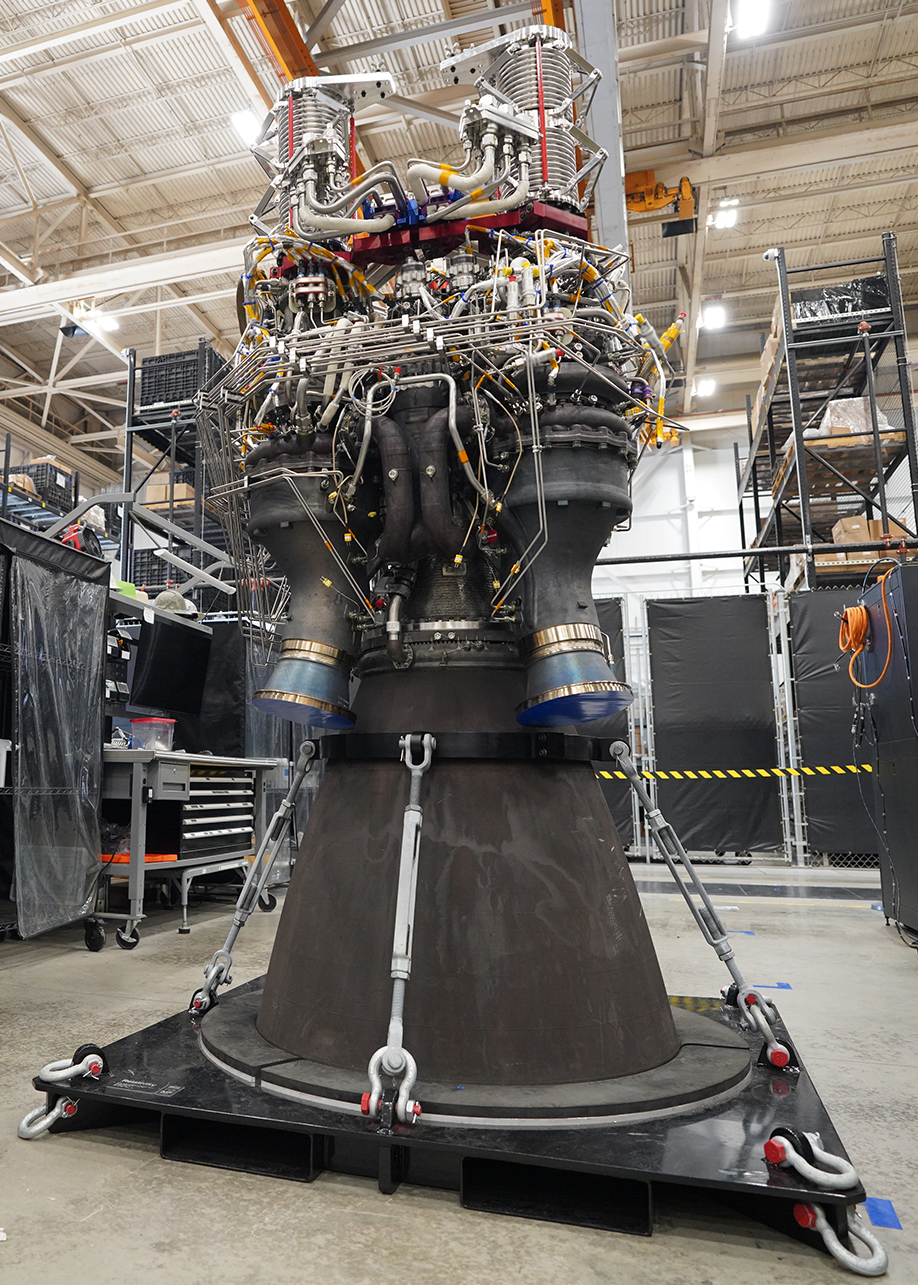
An 18 ft 3D printed dome by our fourth generation Stargate 3D metal printers hangs above a 6 ft 3D printed Aeon R engine


AEON R

ENGINE ETHOS

Designed and manufactured in-house, Aeon R engines are produced with a significant leap forward in additive manufacturing technology, building on the development of our prior engine, Aeon 1.

These new 3D printing capabilities enable the scale required for the higher thrust-class Aeon R engine, continuing to drive part count reductions by designing and printing singular ‘nodes of simplicity’, streamlining many engine elements into unified prints. This innovative design approach supports lowered costs, lowered engine complexity, greater robustness, rapid iteration, and the speed and scale of production required to serve our customers.

STAGE 1

  • 13x 3D-printed Aeon R rocket engines

  • Aeon R sea level thrust of 258,000 lbf,
    combined vehicle liftoff thrust of 3,354,000 lbf

  • LOx/subcooled Methane propellants

  • High pressure gas generator cycle

STAGE 2

  • 1x 3D-printed Aeon Vac engine

  • Aeon R vacuum thrust of 279,000 lbf

  • Subcooled LOx/subcooled Methane propellants

  • High pressure gas generator cycle

First complete Aeon R engine build


AEON R TESTING

Aeon R thrust chamber assembly (TCA) test at 100% power (March 2023)

Aeon R gas generator (GG) testing (November 2022)


OUR 3D pRINTING AND MATERIALS

Using our 4th Generation Stargate horizontal metal 3D printers, together with advances in powder bed fusion printing, we are strategically focused on reducing vehicle complexity, cost, and iteration speed. With continued company focus on redefining what is possible through large scale additive manufacturing after successfully proving the viability of 3D printed rockets with Terran 1, each Terran R vehicle requires approximately six times the total printed content by mass of each Terran 1.  

From day one, Terran R has been intentionally designed for reusability and a high launch cadence. With this core tenant at the center of all product architecture decisions, we’re continuing to refine the composition of its proprietary aluminum alloy metals, not only optimizing them for strength, but also for reusability. Terran R will initially use the same proprietary printed aluminum alloy as flown and proven on Terran 1 with a focus on supply chain scaling, while a third-generation aluminum alloy designed for improved performance of an orbital vehicle mission life beyond 20 reusable flights is in active development, accelerated by the aid of artificial intelligence-based alloy discovery tools. 


dome-printing.png
 

TERRAN R INFRASTRUCTURE

INNOVATION THROUGH ITERATION 

Terran R’s production home base will be in Long Beach, CA, at our one million square foot headquarters, which are home to our fourth generation Stargate 3D metal printers. At production run rate from this single factory, we estimate the ability to initially produce and fly more than 45 Terran R’s annually, with adaptive software-driven production infrastructure able to build more or less first or second stage components based on reuse rate and customer demand over time. After completion of production and initial structural proto-qualification testing in Long Beach, Terran R vehicles will travel by sea through the Panama Canal to Mississippi for testing and then Florida for launch. 


TESTED AT NASA STENNIS, MS

Announced in October 2022, we’re actively building out additional new test stands and infrastructure on a more than 150-acre expansion to support a high volume of Terran R testing as vehicle production and launch cadence increases. The completion of a new dual-bay vertical engine test stand is expected by beginning of fall 2023, in addition to the multiple test areas at each of our E2 and E4 sites repurposed from Terran 1 development.


LAUNCHED IN CAPE CANAVERAL, FL 

Leveraging Space Launch Complex 16, our current orbital launch site at Space Force Base in Cape Canaveral, FL, we plan to build a secondary launch pad adjacent to existing Terran 1 test and launch facilities. Reused boosters will stay in Florida and be rapidly refurbished for additional launches. 


FOLLOW THE TERRAN R JOURNEY